Hello! I’m Kendal David.I’m a PhD Candidate at Carleton University’s School of Social Work. I study and write about social assistance and disability.I’m a researcher and educator. I'm also a member of the Basic Income Youth Collective, which is a grassroots group of young people who advocate for better income support policies. Prior to my graduate studies, I worked in the disability service sector.I currently live in Ottawa (Anishinaabe Algonquin territory), and was born and raised in Calgary/Mohkinstis (Treaty 7 Territory). I love puzzles, poetry, podcasts, and my ginger tabby cat Charlie.


ODSP BEYOND THE BASICS: Institutional and Boarding Allowances
This report examines the Ontario Disability Support Program's (ODSP) institutional allowance system. The system is complex, poorly understood, and has received very little public, political, and academic attention.This report is intended to be a resource for advocates and researchers who monitor and critique ODSP rates and the administration of the program, especially for those who want to integrate non-standard allowance rates and recipients in their future work.It a product from my doctoral dissertation research, which included a comprehensive policy analysis of key ODSP regulations and their historical amendments, internal government files obtained via Freedom of Information requests, and 19 interviews with institutionalized and boarding ODSP recipients and residence staff.The report can be downloaded for free from ResearchGate at this link.Suggested citation:
David, K.M. (2025, September). ODSP Beyond the Basics: Institutional and Boarding Allowances. www.kendaldavid.ca/#ODSP-beyond-basics

For my PhD dissertation project, I researched how disabled people living in residential care institutions are treated by the Ontario Disability Support Program (ODSP).
Check out this report from my dissertation research:ODSP Beyond the Basics: Institutional and Boarding Allowances
What is this study about?
Income support programs like the Ontario Disability Support Program (ODSP) are important for the survival and well-being of disabled people experiencing poverty. The decisions that governments make when they design and administer these programs have an enormous influence on people’s lives. This is true both for people who receive ODSP and also those who are denied access.Researchers and advocacy organizations know that it is important to monitor the rates of programs like the ODSP, as well as how they are designed and administered. The amount of money people have access to shapes their survival and quality of life. However, very little research has considered the different rates of income supports for people living in congregate (shared) residential settings.This is where my research comes in! I am trying to understand how ODSP works for people who do not live in institutional settings and boarding homes.
How did you do the research?
I did the research in 2 phases.In the first phase, I studied the policies that regulate ODSP. These are legal documents with all the rules that tell ODSP workers how to decide if someone is eligible for income support, how much money they get, and how to make all the other decisions related to ODSP. I'm reading them very closely to understand what the “rules” are for people living in residential care settings. I am using linguistic-informed research methods (critical discourse-historical analysis) to understand which words and grammatical tools the provincial government uses in the policy texts, and how those choices impact the meaning of the texts.In the second phase of research, I did interviews with 19 people who have real-life experience with ODSP and residential care institutions. I asked them questions about their experiences with ODSP and institutional systems. I analyzed the transcripts to develop a more comprehensive picture of how ODSP actually works in real life for real people.My guiding research questions were: 1) How is institutionalization discursively constructed within ODSP’s policy texts? And, 2) What do the experiences of allowance recipients and institution staff tell us about how ableism is manifested through ODSP?
What have you learned about ODSP's institutional allowances?
Stay tuned! This section will be updated with more detailed descriptions of how the allowance schemes work. I'll share a bit about how ODSP categorizes applicants/recipients into 3 broad groups to determine benefit rates: renter/owner, boarder, or institutionalized person. I'll also update this section with themes from my interviews with ODSP recipients and residence staff.Here's a very brief summary of a few things I've learned so far:
• Ontarians with disabilities who live in institutions receive Personal Needs Allowances (PNAs) or Special Boarder Allowances (SBAs) via ODSP, instead of standard social assistance rates. Allowance rates are extremely low at $149 and $71 per month, respectively. These allowances are supposed to cover all personal necessities beyond food and shelter, including clothing, footwear, internet, phone plans, recreation, over-the-counter pharmaceuticals, hairdressing, menstrual products, and more.• Approximately 14,000 ODSP recipients reside in institutions and receive PNAs of $149 per month, and approximately 48,000 ODSP recipients are boarders, receiving SBAs of $71 per month. These Ontarians account for about 18% of the total ODSP caseload.• Interviews find that recipients use their PNAs or SBAs to cover necessities that should be provided by institutions, including food.• Allowance recipients face challenges contacting their ODSP caseworkers, exacerbated by lack of access to communication technologies due to poverty.• This government’s efforts to improve ODSP by indexing rates are not reaching this 18% of ODSP recipients, because PNAs and SBAs are excluded from O. Reg 2/23. This leaves some of the poorest Ontarians behind as the cost-of-living skyrockets year over year. Rates have not changed since 2018, when they increased by $3 per month for PNAs and $2 per month for SBAs.• PNA and SBA rates should be increased and indexed to reflect the realities of recipient needs and institutional provisions. Improving other regulations (e.g., improved service standards for domiciliary hostels and banning sheltered workshops) would also help to mitigate disability poverty.
What can I do if I think these allowance rates are way too low for anyone to survive on?
Great question! ODSP's institutional allowance scheme is deeply flawed and wildly inadequate. Rates should be significantly increased (to at least $600/month) and indexed annually so they keep up with inflation.I am developing some resources that you can use to contact your MPP if you're an Ontario resident. Stay tuned!For now, you can check out the briefing note I am using for my own advocacy on this issue. Consider writing to your MPP to tell them that you think ODSP's institutional allowance scheme needs to be fixed! You can figure out who your MPP is and how to contact them here (link goes to Legislative Assembly of Ontario webpage called "Find your MPP").
You can also support the important advocacy work of the Raise the Rates campaign, which has been calling on the Ontario government to double all social assistance rates. Read more about them here (link directs you to the Raise the Rates website).
Chat with me!
If you have any questions about my work, ideas for future directions, or just want to chat more, please reach out to me (link takes you directly to my contact page).
I'm a researcher, educator, and community organizer. These days, I am most often studying, teaching, and writing about poverty and disability.My academic work engages with the fields of social policy studies, critical disability theories, and critical discourse studies.On this page, you can check out some of my published articles, teaching experience, creative projects, and more!
On this page: Teaching and Facilitation, Research, Academic Articles, Other Published Work
TEACHING
AND
FACILITATION
I love working with students and community groups. I pride myself in being an engaging and accessible facilitator.In Fall 2025, I'm teaching Social Work and Disability at Carleton University. In 2024, I taught Social Work Practice with Groups and Communities, and Research Methods in Social Work.I am regularly invited as a guest lecturer to university classrooms and as a public speaker for community events to talk about basic income, community social work and activism, disability studies, income security, social policy, and more.Please do not hesitate to reach out (link takes you directly to my contact page) to chat about co-creating a lecture or workshop.
RESEARCH
I spend lots of time reading, writing, and talking about: social assistance and other income supports, basic income, critical disability studies, and feminist disability theory. I regularly use critical discourse analysis as a research methodology.I strive to make my research useful, accessible, and engaging.My academic work takes place across a variety of mediums. On this page, you’ll find some of my work, which includes zines, interviews on podcasts, and peer-reviewed scholarly articles.To read more about my current/ongoing PhD research, visit the ODSP Study page of this website. To check out a more comprehensive catalogue of my past research, visit my ResearchGate profile.
ACADEMIC ARTICLES
LATEST: Mobilizing feminist disability studies for expansive social work scholarship
In this open access article, I trace the evolution of feminist disability studies (FDS) as an academic field. In doing so, I highlight some of the ways that FDS offers rich conceptualizations of phenomena relevant to social work scholarship. Despite shared issues of interest, there is still more potential for FDS to be used in social work theory and research. I suggest future directions for social work research that includes ideas from FDS.
Published in the British Journal of Social Work in March 2025.
MSW Thesis: Weaving and unraveling dominance
My MSW thesis explored and challenged what it means to be a social worker in Alberta. Grounded in critical and anti-oppressive theories and methodologies – namely critical disability studies and critical discourse analysis – I critiqued how dominance and power are woven into narratives of identity, belonging, and pride within interview data with practicing social workers.I reflected on what social work could become when the rigid exclusionary boundaries of the profession are unraveled and reimagined.
Enough is enough, social work!
With colleagues Maimuna Khan and Dr. Yahya El-Lahib, I co-authored a book chapter entitled "Enough is enough, social work! A critical disability interrogation of social work’s approaches to working with people with intellectual and developmental disabilities." The chapter was published in Social Work Practice in Autism and Developmental Disabilities (Stoddart & Fudge Schormans, eds.). Please contact me if you cannot access the chapter behind a paywall.
Wooden spoons and “Pulling the mom card”
In June 2023, a peer-reviewed article I wrote based on my MSW thesis data was published in Critical Social Work.
Analysis of the Ontario Poverty Reduction Strategy
Alongside Dr. Tracy Smith Carrier, I co-authored a peer-reviewed journal article analyzing ableist discourses in Ontario’s third poverty reduction strategy.
“I was trusted for once”: Imagining more humane income supports through the Ontario Basic Income Pilot
This open access article analyzes how the Ontario Basic Income Pilot shaped participants' understanding of the possibility of more humane income supports. It was published in Social Policy and Society in December 2024.
Life on basic income: Stories from Southern Ontario
As a Research Assistant for the SSHRC-PEG funded research project Experiences of the Ontario Basic Income Pilot, I have worked on several articles and reports sharing about the transformative impact of the Pilot.You can read a comprehensive summary of the research findings in our report “Life on Basic Income: Stories from Southern Ontario”.
OTHER PUBLISHED WORK

LATEST: ODSP Beyond the Basics
This report examines the Ontario Disability Support Program's (ODSP) institutional allowance system. The system is complex, poorly understood, and has received very little public, political, and academic attention.This report shares technical findings from my PhD research. It is intended to be a resource for advocates and researchers who monitor ODSP's rates and administration, especially for those who want to integrate non-standard allowance rates and recipients in their future work.
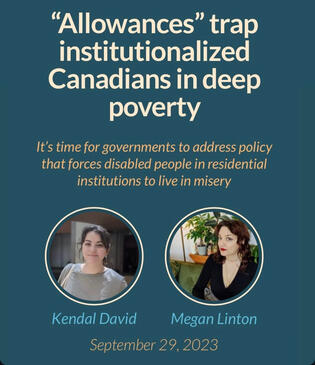
Institutional allowances article for Monitor Magazine
I co-wrote an article with Megan Linton about the inadequacy of institutional allowance schemes for people with intellectual/developmental disabilities in Canada experiencing contemporary institutionalization. The piece was published by the Canadian Centre for Policy Alternative's Monitor Magazine.

GBI for PEI
I co-authored “A Proposal for a Guaranteed Basic Income Benefit in Prince Edward Island”, which was released in November 2023.The report has received regional and national media attention, as well as a formal endorsement and response from the Government of Prince Edward Island who are currently pursuing discussions with the federal government about the program.
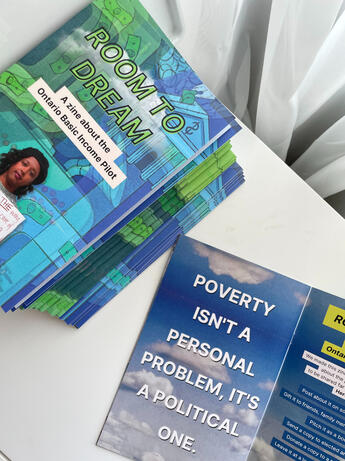
Room to Dream
In 2023, I co-authored and co-designed an arts-based zine to mobilize research findings from the Ontario Basic Income Pilot, in collaboration with Chloe Halpenny.
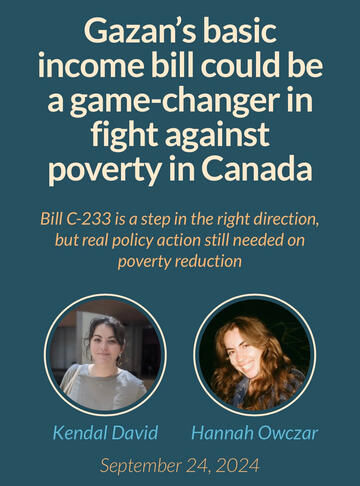
Basic income article for Monitor Magazine
I co-wrote an article with Hannah Owczar (another member of the Basic Income Youth Collective) about MP Leah Gazan's efforts to make basic income a reality in Canada via Bill C-223. The piece was published by the Canadian Centre for Policy Alternative's Monitor Magazine.
Opinion: Disability Benefit regulations show feds don’t care about institutionalized Canadians
For the Hill Times, I co-wrote an article with Megan Linton about the Canada Disability Benefit regulations and the absence of institutionalized Canadians within them (September 29, 2024). If you can't access to article behind the paywall, you can read it here instead.
Appointed Interview
In October 2023, I was interviewed by Senator Kim Pate for her podcast Appointed about disability poverty, income security, and youth organizing for policy change.
Get in touch!
I'd love to hear from you! I value and invite opportunities to build collaborative and kind relationships within my academic and community organizing practice – feel free to email me to connect and chat!